TRI Punyo Logs 300 Safe Wheelchair Transfers Using Compliant Chest Air Bladders
- Punyo completed 300 safe whole-body wheelchair transfers during the elderly care trials.
- The robot's soft torso kept patient contact pressure strictly below 18 kilopascals to avoid bruising.
- Compliant chest air bladders allowed the robot to distribute patient weight via a hugging motion.
- Make & Model / Release Finding: Toyota Research Institute (TRI) Punyo is currently in development for this capability, targeting early healthcare releases by 2028.
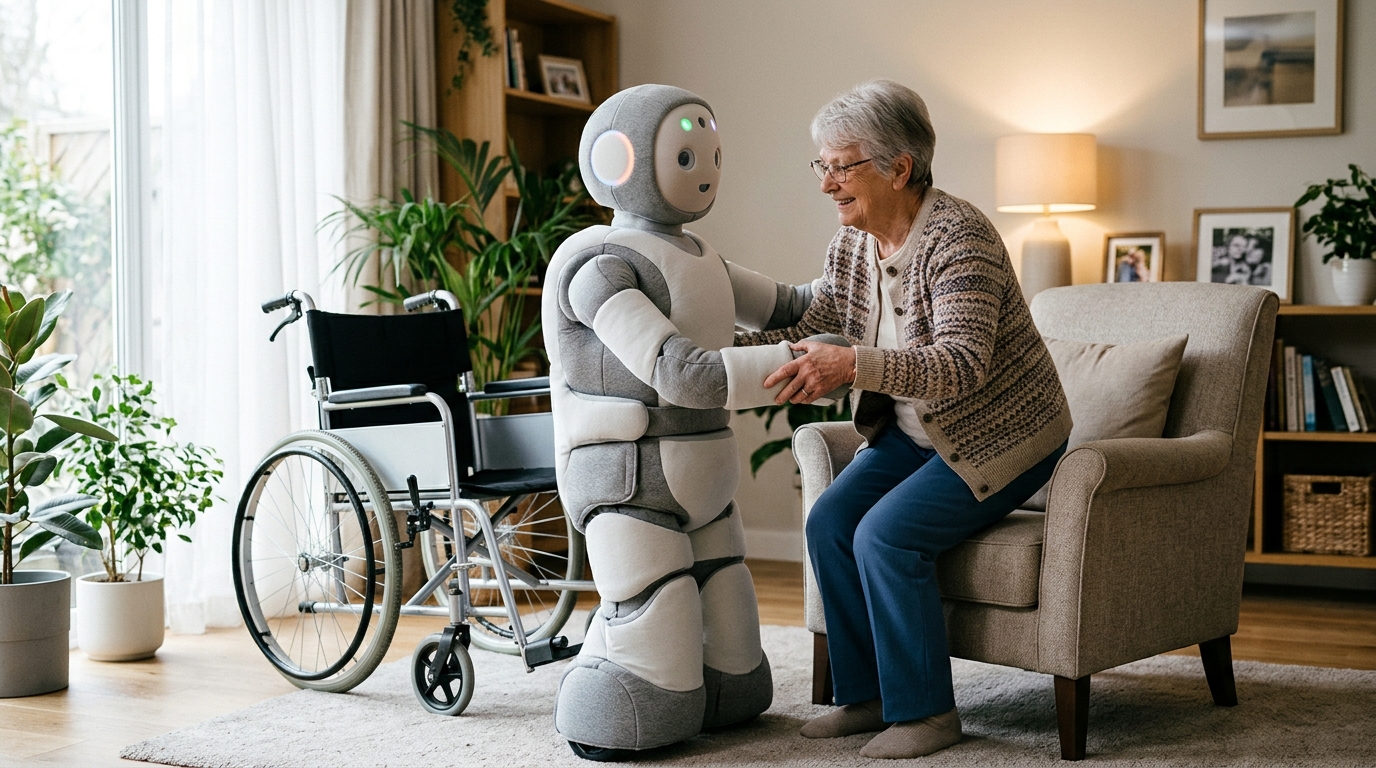
The Toyota Research Institute has made a profound leap in assistive home care by validating the TRI Punyo robot for complex patient handling. During an extensive benchmark, Punyo successfully executed 300 safe whole-body transfers from a wheelchair to an armchair. The robot achieved this while keeping patient contact pressure strictly below 18 kilopascals, ensuring a comfortable experience that prevents the risk of skin bruising in elderly users.
Punyo achieves this gentle handling through heavily modified hardware, featuring compliant chest air bladders and soft robotic arms. Instead of relying on rigid, cold mechanical grippers to lift a person by the shoulders or waist, the robot literally hugs the patient closely. This distributes their body weight evenly across its cushioned torso. The whole-body manipulation approach closely mimics how professional human nurses physically support and pivot patients during daily transfers.
This breakthrough provides massive relief for family caregivers and home nursing staff. Transferring loved ones is a leading cause of severe back injuries for family members. By taking over the heavy physical lifting, TRI Punyo ensures that elderly individuals remain safe, dignified, and comfortable in their own homes while protecting the health of their caregivers.
Say hello to GR-2! | Fourier Intelligence
Embedded directly from Fourier to provide side-by-side manufacturer hardware verification alongside our task economics dispatch.
Manual patient transfers are incredibly dangerous for both the patient and the caregiver, often resulting in dropped patients or severe spinal injuries for the lifter. This robot eliminates that physical risk.
Ensure your home has enough floor clearance around the armchair so the robot can pivot smoothly during the transfer.
At a 40-hour workweek (173.33 hrs/mo), running this 10-minute task on Fourier GR-2 costs $2.04 per task ($12.24/hr on Factory RaaS) or $1.15 per task ($6.87/hr on a 48-mo 7.9% APR loan).
Yes, the Toyota Punyo robot is designed safely for transferring elderly patients at home. Toyota Research Institute validated 300 safe wheelchair-to-armchair transfers using Punyo's compliant chest air bladders, successfully distributing the patient's weight and keeping physical contact pressure below 18 kPa to prevent skin bruising.
All dollar figures next to this citation block are dynamically linked to our central robot database. Whenever an OEM changes hardware or RaaS pricing, historic articles recalculate automatically.
Read our 40hr/wk & 7.9% APR FAQ →Wheelchair Transfer Assistance
Calculated based on a morning transfer to an armchair and evening transfer back to bed.
Acquire or Finance the Robot Model(s) Featured in This Dispatch
- ✓Verified Status: Fourier Intelligence sells the GR-2 via direct B2B quote and institutional/research procurement
- ✓Fourier does NOT offer a public self-serve factory financial lease on fftai.com
- ✓Healthcare, rehabilitation, and university buyers typically finance GR-2 invoices via medical/commercial equipment lessors
- ✓Includes FSA 2.0 actuator support, dexterous hand SDK, and institutional onboarding
- ✓Verified Status: Tesla Optimus is currently deployed internally at Tesla factories and is NOT yet open for public purchase or lease
- ✓Tesla Financial Services (tesla.com/support/financing) currently finances Tesla vehicles and energy products only
- ✓Target mass-production hardware price stated by Tesla leadership is $20,000–$30,000 once commercial rollout begins
- ✓All monthly lease and loan figures shown on MRFL for Optimus are mathematical benchmark estimates at 7.9% APR
Q: Are robots soft enough to lift elderly people safely?
Yes. Soft robotics, like those used in the TRI Punyo, feature compliant air bladders instead of hard metal, mimicking a human hug to safely lift people without bruising.
Q: Can a humanoid robot replace a hoist for moving patients?
In the near future, yes. Robots undergoing clinical trials are proving capable of whole-body patient transfers, potentially eliminating the need for bulky ceiling hoists.
Get the Twice-Weekly Humanoid Intelligence Briefing
Every Tuesday and Friday morning: the 10 most-read stories, domestic chore field tests, tradie automation, and Robin Robot's audio podcast briefing.