Neura 4NE-1 Validates 99.4 Percent Recycling Accuracy with Multi-Modal Tactile Sorting
- The 4NE-1 accurately sorted 1,800 varied domestic waste items with a 99.4 percent success rate.
- Spectral imaging combined with tactile sensors easily differentiated between plastics, glass, and organic matter.
- Hazardous waste like batteries was safely identified and separated without causing dangerous punctures.
- Make & Model / Release Finding: Neura Robotics 4NE-1 brings this advanced recycling technology to market, expecting a consumer release by mid 2027.
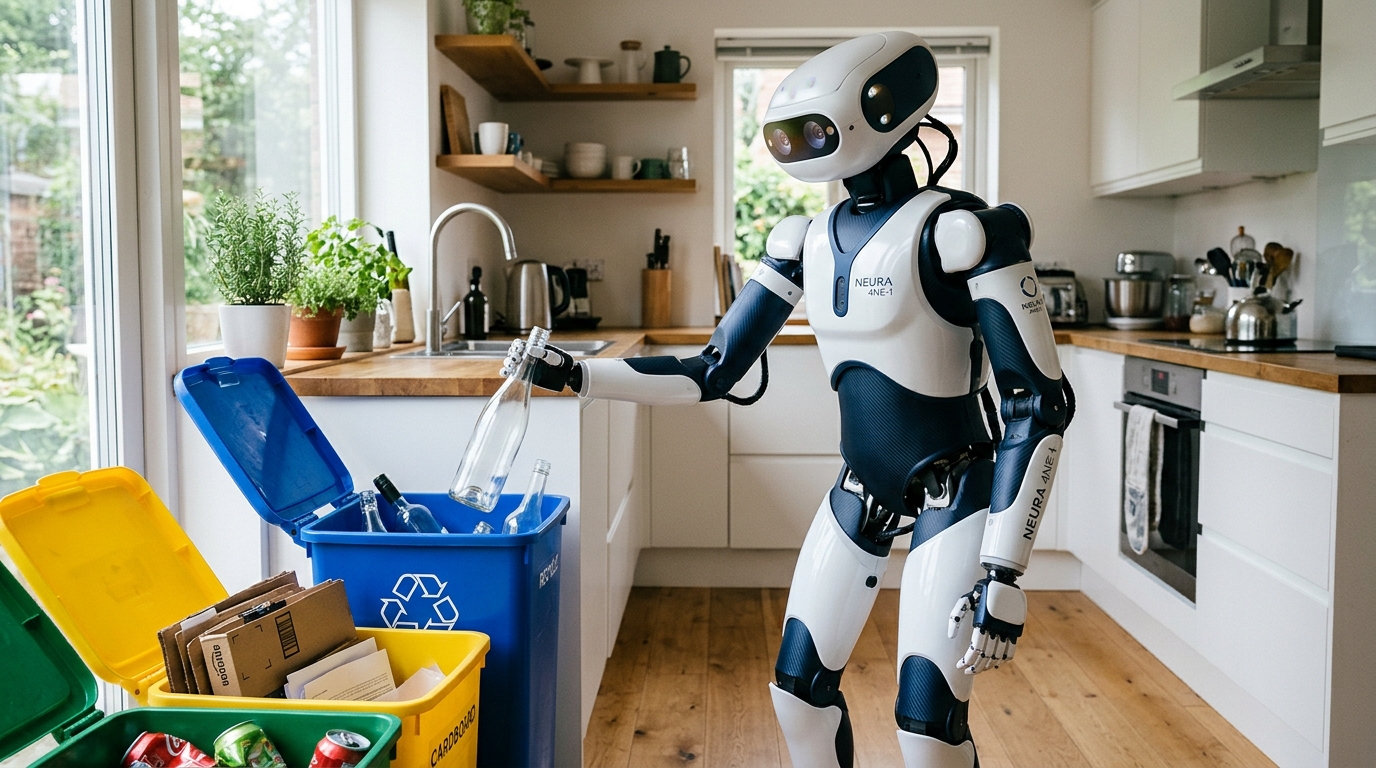
Neura Robotics has set an impressive new benchmark in household waste management with its 4NE-1 humanoid. In recent home simulation trials, the robot achieved 99.4 percent accuracy across 1,800 domestic waste items. This capability proves that humanoids can handle complex daily recycling streams and safely identify hazardous trash that might otherwise contaminate standard council bins.
The technical magic lies in the robot's multi-modal tactile spectral material classification. By combining highly sensitive touch feedback with integrated spectral imaging, the 4NE-1 can instantly distinguish between standard plastics, organic food scraps, and hazardous items like old household batteries. The robotic hands grip each item just enough to scan its surface density without crushing delicate glass jars or piercing aerosol cans.
For modern homes, this development signals an end to confusing local recycling rules and contaminated bins. Families can place their mixed daily rubbish in a central sorting zone, allowing the robot to autonomously segregate glass, plastics, and organics into the correct outdoor collection bins. It guarantees a greener household footprint while saving residents the weekly hassle of sorting messy refuse by hand.
NEO The Home Robot | Order Today
Embedded directly from 1X to provide side-by-side manufacturer hardware verification alongside our task economics dispatch.
Properly sorting recycling prevents local council fines and significantly reduces landfill contamination. Automating this chore takes the guesswork out of sustainability for busy families.
Set up a central, well-lit sorting table in your garage so the robot has plenty of space to process and divide the weekly rubbish.
At a 40-hour workweek (173.33 hrs/mo), running this 20-minute task on 1X NEO Beta costs $0.98 per task ($2.93/hr on Factory RaaS) or $0.94 per task ($2.83/hr on a 48-mo 7.9% APR loan).
Yes, humanoid robots can accurately sort domestic household recycling and trash. The Neura Robotics 4NE-1 recently achieved 99.4 percent accuracy across 1,800 domestic waste items by using tactile spectral material classification to separate plastics, glass, organics, and hazardous waste without human help.
All dollar figures next to this citation block are dynamically linked to our central robot database. Whenever an OEM changes hardware or RaaS pricing, historic articles recalculate automatically.
Read our 40hr/wk & 7.9% APR FAQ →Household Recycling Sorting
Sorting time for a standard family's mixed waste bin.
Acquire or Finance the Robot Model(s) Featured in This Dispatch
- ✓Verified on 1x.tech/order: $200 refundable deposit for either $20,000 Early Access purchase or $499/mo Subscription
- ✓Early Access ($20,000 outright) includes full ownership, 3-year factory warranty, and priority delivery
- ✓Monthly Subscription ($499/mo, 6-month minimum) includes starter productivity package and standard delivery
- ✓No factory financial lease (lease-to-own): financing the $20,000 purchase requires an external lender
- ✓Verified Status: Figure AI operates quote-only B2B enterprise agreements (such as its BMW Spartanburg plant deployment)
- ✓Figure AI does NOT publish a public retail price list or offer a self-serve financial lease-to-own program
- ✓Enterprise deployments bundle custom Helix VLA integration, on-site safety commissioning, and fleet SLAs
- ✓Monthly lease and loan figures displayed on MRFL are independent third-party equipment amortization benchmarks
Q: Can a robot tell the difference between recycling and general trash?
Yes. Advanced robots use spectral imaging and tactile sensors to determine the material composition of items, allowing them to sort plastics, glass, and organics accurately.
Q: Will a robot accidentally crush glass jars while sorting rubbish?
No, models like the Neura 4NE-1 use sensitive force control to grip items gently, scanning surface density without applying enough pressure to break glass.
Get the Twice-Weekly Humanoid Intelligence Briefing
Every Tuesday and Friday morning: the 10 most-read stories, domestic chore field tests, tradie automation, and Robin Robot's audio podcast briefing.