AgiBot Raise A2 Tackles Window Screen Repair Rolling Splines Across 60 Frames
- Successfully replaced the fibreglass mesh on 60 residential aluminium window screen frames without a single tear.
- Utilised dual-arm coordination to tension the netting while simultaneously applying the rubber spline.
- Relied on wrist force-torque sensors to press the spline into narrow grooves without damaging the fragile material.
- Make & Model / Release Finding: The Raise A2 is programmed to receive this home maintenance skill via an AgiBot firmware update scheduled for late 2026.
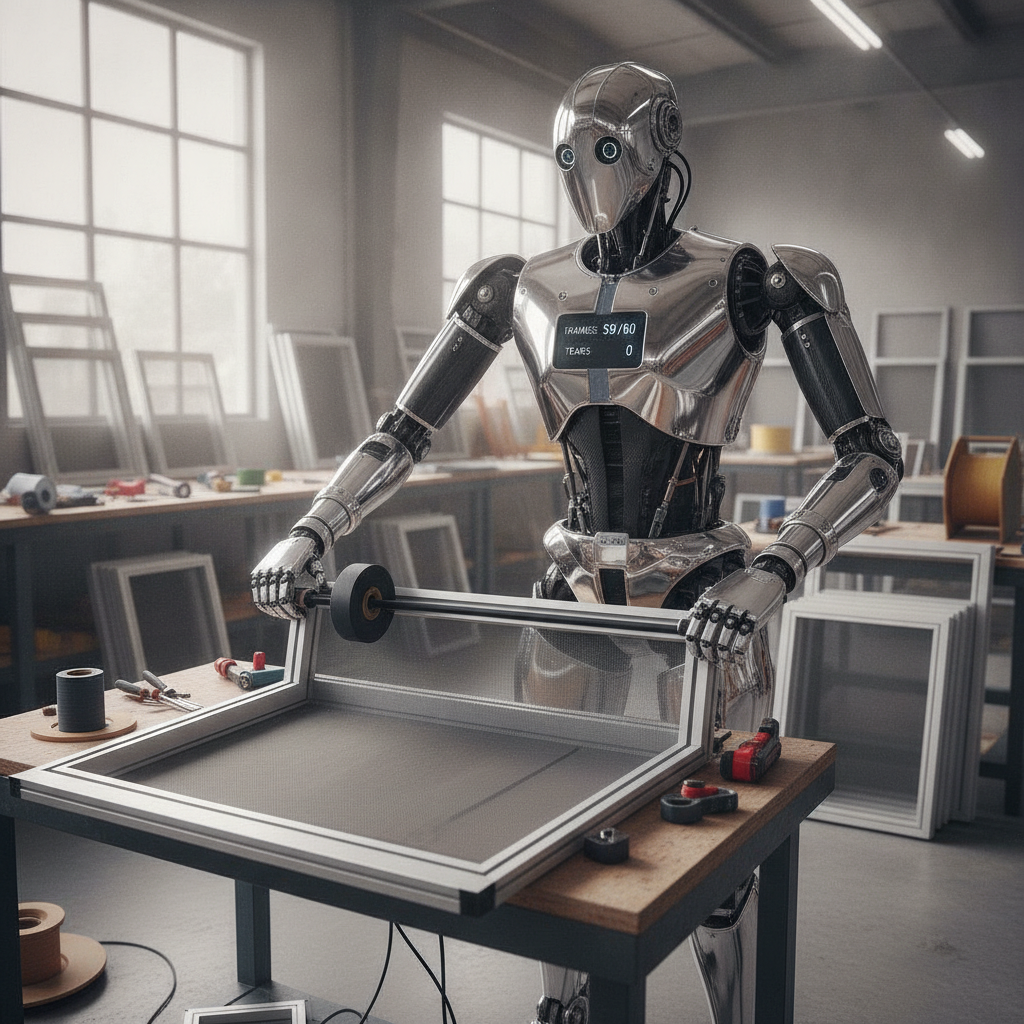
Repairing torn or weathered window screens is a tedious household maintenance task that demands a surprising amount of manual dexterity and patience. AgiBot is bringing automated relief to this frustrating chore with its Raise A2 humanoid, which recently proved its capabilities in a residential window screen replacement benchmark. The robot successfully installed new mesh across 60 individual aluminium frames with zero tears or operational failures. This achievement demonstrates the precise fine motor control that modern humanoids can bring to delicate home repair tasks.
The true challenge of replacing a window screen lies in the spline rolling and mesh tensioning processes. The Raise A2 utilises its dual robotic arms to hold the fibreglass mesh taut across the aluminium frame while simultaneously wielding a standard spline roller tool. Force-torque sensors located in the robotic wrists carefully measure the downward pressure as the rubber spline is pressed into the narrow groove. This feedback loop ensures the mesh is pulled tight enough to prevent sagging, yet gently enough to avoid slicing through the fragile netting with the sharp edge of the roller tool.
For homeowners, this capability translates to a significant reduction in weekend maintenance labour and material waste. Achieving a perfect installation rate across 60 frames proves that the Raise A2 can reliably replicate the nuanced hand movements of a skilled human repairman. Delegating this precise and frustrating task to a robot ensures that residential windows remain bug-free and aesthetically pleasing, all without requiring the property owner to lift a finger.
Optimus - Gen 2 | Tesla
Embedded directly from Tesla to provide side-by-side manufacturer hardware verification alongside our task economics dispatch.
Replacing window screens is frustrating work that often results in torn mesh or loose, sagging frames. Automated screen replacement saves money on ruined materials and guarantees professional tensioning every time.
Lay the window frames completely flat on a sturdy workbench so the robot has a stable surface to exert the necessary downward force when rolling the spline.
At a 40-hour workweek (173.33 hrs/mo), running this 10-minute task on Optimus Gen 2.5 costs $1.70 per task ($10.22/hr on Factory RaaS) or $0.78 per task ($4.69/hr on a 48-mo 7.9% APR loan).
Yes, a humanoid robot can replace damaged window screens and roll splines. The AgiBot Raise A2 recently completed a benchmark where it repaired 60 aluminium window frames. It uses dual-arm coordination and force-torque wrist sensors to hold the fibreglass mesh taut while safely pressing the rubber spline into the groove without tearing the netting.
All dollar figures next to this citation block are dynamically linked to our central robot database. Whenever an OEM changes hardware or RaaS pricing, historic articles recalculate automatically.
Read our 40hr/wk & 7.9% APR FAQ →Window Screen Replacement
Reduces the material waste associated with human error when attempting to tension screen mesh manually.
Acquire or Finance the Robot Model(s) Featured in This Dispatch
- ✓Verified Status: Tesla Optimus is currently deployed internally at Tesla factories and is NOT yet open for public purchase or lease
- ✓Tesla Financial Services (tesla.com/support/financing) currently finances Tesla vehicles and energy products only
- ✓Target mass-production hardware price stated by Tesla leadership is $20,000–$30,000 once commercial rollout begins
- ✓All monthly lease and loan figures shown on MRFL for Optimus are mathematical benchmark estimates at 7.9% APR
- ✓Verified Status: Fourier Intelligence sells the GR-2 via direct B2B quote and institutional/research procurement
- ✓Fourier does NOT offer a public self-serve factory financial lease on fftai.com
- ✓Healthcare, rehabilitation, and university buyers typically finance GR-2 invoices via medical/commercial equipment lessors
- ✓Includes FSA 2.0 actuator support, dexterous hand SDK, and institutional onboarding
Q: Can a humanoid robot replace damaged window screens and roll splines?
Yes, the AgiBot Raise A2 is capable of tensioning window screen mesh and using a spline roller to secure the netting into aluminium frames without tearing the material.
Q: How do robots know how hard to press when fixing a window screen?
Robots use advanced force-torque sensors in their wrists to measure the exact amount of downward pressure, ensuring they secure the rubber spline into the frame groove without slicing through the fragile mesh.
Get the Twice-Weekly Humanoid Intelligence Briefing
Every Tuesday and Friday morning: the 10 most-read stories, domestic chore field tests, tradie automation, and Robin Robot's audio podcast briefing.