AgiBot Raise A2 Lays 120 Square Meters of Click-Lock Flooring in Residential Fitout Trial
- The AgiBot Raise A2 successfully installed 120 square metres of click-lock luxury vinyl plank flooring in field trials.
- Force-torque sensors allowed the robot to snap rigid core planks together without breaking the delicate tongue and groove edges.
- Visual odometry and a rubber mallet tool enabled the system to maintain sub-millimetre seam closure across the residential floorplan.
- Make & Model / Release Finding: The AgiBot Raise A2 is expected to begin commercial deployment in 2027, with the manufacturer partnering directly with top-tier commercial construction firms in China.
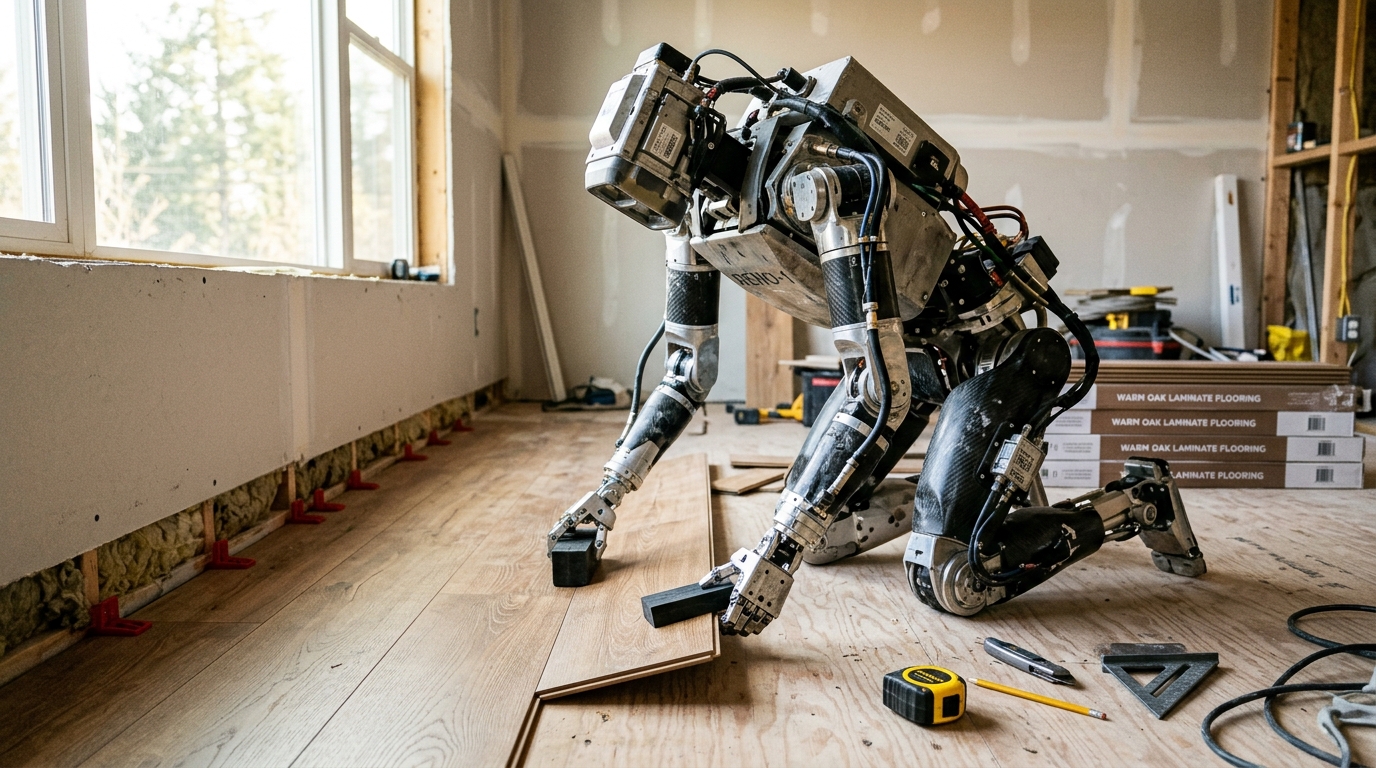
Residential construction fitouts have traditionally relied on gruelling manual labour to complete large scale flooring projects. However, the AgiBot Raise A2 humanoid robot has recently demonstrated an impressive leap in automated tradesmanship. During recent field benchmarks in China, this advanced bipedal system successfully installed 120 square metres of click-lock luxury vinyl plank flooring in a residential setting. The trials revealed that the robot could continuously lift, align, and snap the rigid core planks into place with remarkable consistency. By leveraging integrated force-torque sensors in its hands, the AgiBot Raise A2 managed the delicate balance between applying enough pressure to engage the locking mechanism and preventing damage to the vulnerable tongue and groove edges.
What sets this benchmark apart is the sub-millimetre seam closure achieved across the entire installation space. Humanoid robots have struggled in the past with the precise spatial awareness required to keep long runs of flooring perfectly square. The AgiBot engineering team solved this by deploying a high-resolution visual odometry system alongside tactile feedback loops. As the robot moves across the subfloor, it constantly checks the alignment of each newly laid plank against a virtual baseline map. If a plank requires tapping to close a micro gap, the system gently applies corrective force using a rubber mallet tool, mimicking the exact technique used by professional human installers on a daily basis.
For small business owners and residential builders, these results point to a future where robots can handle the most physically demanding aspects of interior finishing. Laying 120 square metres of flooring involves hundreds of repetitive bending and lifting motions that routinely cause joint strain in human workers. Delegating this heavy lifting to the AgiBot Raise A2 allows skilled carpenters to focus on complex custom cuts around doorways and cabinetry. While widespread commercial availability is still on the horizon, this successful trial proves that modern humanoid hardware is rapidly approaching the dexterity and stamina required for rigorous construction site duties.
Optimus - Gen 2 | Tesla
Embedded directly from Tesla to provide side-by-side manufacturer hardware verification alongside our task economics dispatch.
Automating flooring installations directly addresses the severe manual labour shortage in residential construction. This allows building businesses to scale faster while protecting their human staff from chronic knee and back injuries.
Builders should monitor bipedal automation solutions for repetitive fitout tasks to help reduce site overhead costs.
At a 40-hour workweek (173.33 hrs/mo), running this 480-minute task on Optimus Gen 2.5 costs $81.72 per task ($10.22/hr on Factory RaaS) or $37.50 per task ($4.69/hr on a 48-mo 7.9% APR loan).
Yes, the AgiBot Raise A2 humanoid robot can install residential flooring. In recent field benchmarks, the bipedal system successfully laid 120 square metres of click-lock luxury vinyl plank flooring. It achieved sub-millimetre seam closure using force-torque sensors to gently snap planks together without damaging delicate edges.
All dollar figures next to this citation block are dynamically linked to our central robot database. Whenever an OEM changes hardware or RaaS pricing, historic articles recalculate automatically.
Read our 40hr/wk & 7.9% APR FAQ →Vinyl Plank Flooring Installation
Based on continuous operation for a standard 120 square metre residential fitout.
Acquire or Finance the Robot Model(s) Featured in This Dispatch
- ✓Verified Status: Tesla Optimus is currently deployed internally at Tesla factories and is NOT yet open for public purchase or lease
- ✓Tesla Financial Services (tesla.com/support/financing) currently finances Tesla vehicles and energy products only
- ✓Target mass-production hardware price stated by Tesla leadership is $20,000–$30,000 once commercial rollout begins
- ✓All monthly lease and loan figures shown on MRFL for Optimus are mathematical benchmark estimates at 7.9% APR
- ✓Verified Status: Figure AI operates quote-only B2B enterprise agreements (such as its BMW Spartanburg plant deployment)
- ✓Figure AI does NOT publish a public retail price list or offer a self-serve financial lease-to-own program
- ✓Enterprise deployments bundle custom Helix VLA integration, on-site safety commissioning, and fleet SLAs
- ✓Monthly lease and loan figures displayed on MRFL are independent third-party equipment amortization benchmarks
Q: Can humanoid robots lay residential flooring?
Yes. Recent trials with the AgiBot Raise A2 demonstrate that humanoid robots can successfully lift, align, and install click-lock luxury vinyl plank flooring.
Q: How do robots snap flooring planks together without breaking them?
Advanced robots use integrated force-torque sensors in their hands and visual odometry to apply the precise amount of pressure needed to engage the locking mechanisms gently.
Get the Twice-Weekly Humanoid Intelligence Briefing
Every Tuesday and Friday morning: the 10 most-read stories, domestic chore field tests, tradie automation, and Robin Robot's audio podcast briefing.