NVIDIA Isaac GR00T N1.5 and Jetson Thor Unlock Local Open-Weight LLM Control for Consumer and Prosumer Humanoids
- Reality Check: NVIDIA does not sell a standalone consumer household robot; it supplies the Jetson Thor (2,070 FP4 TFLOPS) and $249 Jetson Orin Nano Super brains used by partner OEMs.
- NVIDIA Isaac GR00T N1.5-3B provides open weights on Hugging Face, separating System 2 (VLM/LLM reasoning) from System 1 (flow-matching motor control).
- Owners of open-SDK robots (Unitree G1 EDU, Booster T1, Reachy Mini) can run any quantized open LLM (Llama, Qwen, Gemma, Nemotron) locally via llama.cpp or TensorRT-LLM.
- Make & Model / Release Finding: Jetson Orin Nano Super and GR00T N1.5 weights are live today; Jetson Thor powers reference humanoids like Agile ONE SN and Digit 5.
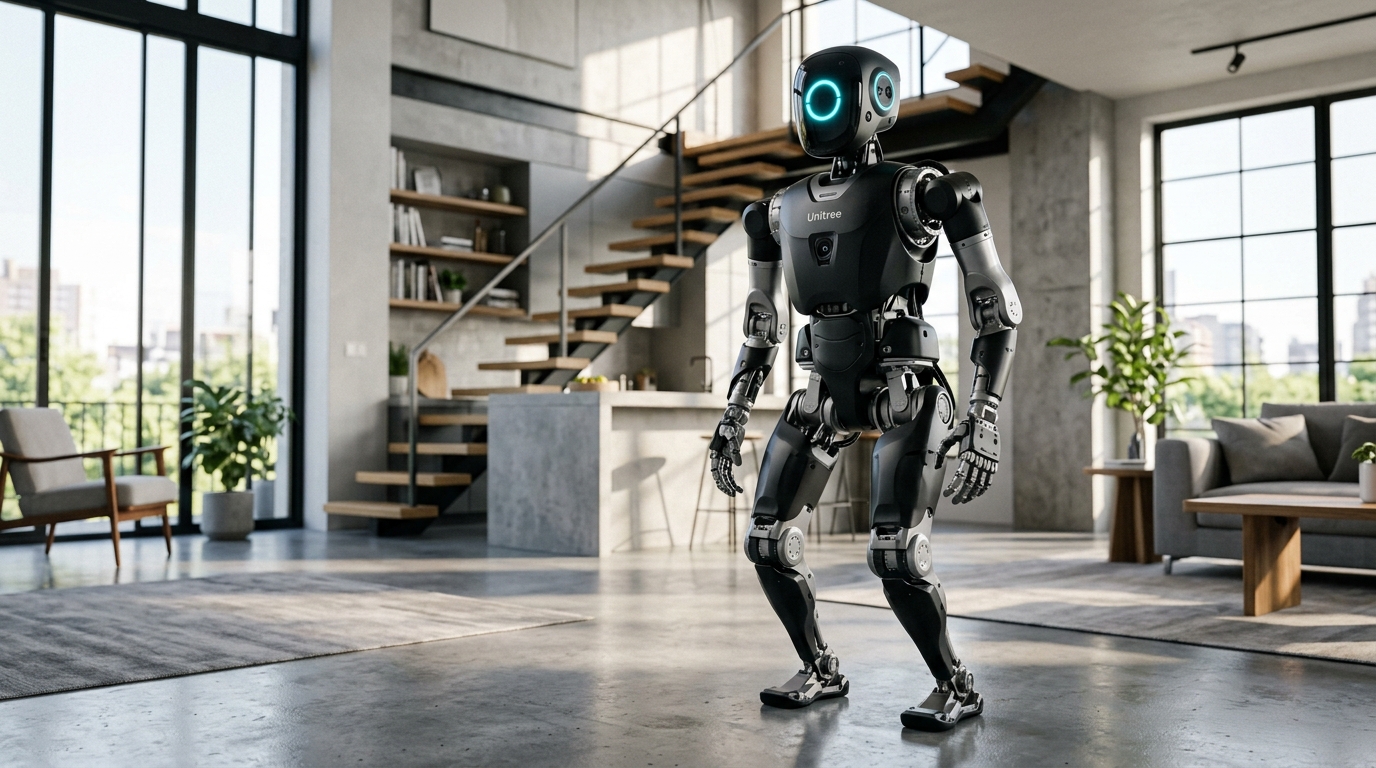
A critical buyer question in consumer and prosumer robotics is whether NVIDIA has launched its own household robot—and whether owners can run any Large Language Model (LLM) of their choice on it. The empirical reality is that NVIDIA is not manufacturing a branded living-room butler of its own. Instead, NVIDIA has positioned itself as the open compute and foundation-model backbone for the entire physical AI industry, enabling third-party consumer, desktop, and developer humanoids to run open-weight LLMs and Vision-Language-Action (VLA) policies locally on the edge without corporate cloud lock-in.
At the center of this architecture is NVIDIA Isaac GR00T N1 and N1.5-3B, whose weights and fine-tuning pipelines are publicly available on Hugging Face and GitHub. GR00T N1.5 uses a dual-system cognitive design: System 2 acts as the deliberative reasoning brain powered by a Vision-Language Model that interprets natural speech, workspace cameras, and multi-step instructions, while System 1 is a fast flow-matching action transformer that translates those semantic plans into smooth, real-time motor trajectories. Because the high-level reasoning layer is modular, developers and prosumers can route any open-source LLM—such as Meta Llama 3.3, Alibaba Qwen, Google Gemma, Mistral, or NVIDIA Nemotron Nano—via llama.cpp, Ollama, or TensorRT-LLM directly into the robot's task planner.
On the hardware side, NVIDIA anchors two distinct tiers: the $249 Jetson Orin Nano Super (67 INT8 TOPS) for compact desktop and entry-level companion robots like the Hugging Face Reachy Mini, and the Blackwell-powered Jetson Thor (delivering up to 2,070 FP4 TFLOPS and 128 GB of unified memory inside a 40W to 130W envelope) for full-scale humanoids including the Agile ONE SN, Plim Step-In, and Unitree G1 EDU configurations. Paired with the open-source Newton physics engine co-developed by NVIDIA, Google DeepMind, and Disney Research—famously demonstrated on stage via Disney's expressive Blue droid—this stack gives robotics buyers a verified path to own hardware where the cognitive LLM brain remains 100 percent swappable and private.
Unitree G1 mass production version, leap into the future!
Embedded directly from Unitree Robotics to provide side-by-side manufacturer hardware verification alongside our task economics dispatch.
Cloud-tethered home robots create privacy risks and subscription lock-in. Running open-weight LLMs and NVIDIA GR00T policies locally on Jetson hardware guarantees your robot keeps working offline with full camera privacy.
Verify that a robot exposes a native ROS 2 or Python LeRobot interface and an onboard NVIDIA Jetson module before purchasing if you plan to swap or self-host custom LLMs.
At a 40-hour workweek (173.33 hrs/mo), running this 20-minute task on Unitree G1 Humanoid costs $1.74 per task ($5.23/hr on Factory RaaS) or $0.71 per task ($2.13/hr on a 48-mo 7.9% APR loan).
NVIDIA does not sell a branded consumer household robot of its own; instead, it provides the open Isaac GR00T N1.5 foundation model and Jetson Thor / Orin edge computers that power partner robots. By pairing Jetson hardware with Hugging Face LeRobot, llama.cpp, or TensorRT-LLM, owners of open-SDK robots like Unitree G1 EDU, Booster T1, and Reachy Mini can run any open-weight LLM locally.
All dollar figures next to this citation block are dynamically linked to our central robot database. Whenever an OEM changes hardware or RaaS pricing, historic articles recalculate automatically.
Read our 40hr/wk & 7.9% APR FAQ →Local LLM Voice-to-Action Tidying
Zero cloud token API fees when running quantized 3B-8B LLMs and GR00T N1.5 locally on onboard NVIDIA Jetson compute.
Acquire or Finance the Robot Model(s) Featured in This Dispatch
- ✓Verified on shop.unitree.com: Unitree requires 100% upfront payment (PayPal online or B2B wire transfer for G1 EDU)
- ✓Unitree does NOT offer factory financial leasing, installment plans, or factory RaaS on its store
- ✓12-month factory warranty on PMSM joint motors and hardware included with outright purchase
- ✓Financial lease or chattel mortgage must be arranged via a third-party equipment lender or local distributor
- ✓Verified Status: Booster Robotics sells the T1 outright via B2B quote and global distributors (e.g., RobotShop, Generation Robots)
- ✓Booster does NOT provide a direct factory financial lease or in-house credit facility
- ✓Commercial buyers receive an official B2B commercial invoice that can be funded through an external equipment lessor
- ✓Includes standard factory hardware warranty and open-source ROS 2 / locomotion SDK access
Q: Did NVIDIA release a new consumer robot that can run any LLM?
NVIDIA provides the brain rather than a standalone consumer appliance: its open-weights Isaac GR00T N1.5-3B foundation model, Newton physics engine (with Google DeepMind and Disney), and Jetson Thor / Orin Nano Super computers let partner robots run any open LLM locally or via API.
Q: Which robots allow you to plug in and run any open-source LLM in 2026?
Hugging Face and Pollen Robotics' Reachy Mini ($399-$499) and HopeJR (~$3,000), Unitree's G1 EDU and R1 developer editions, Booster T1, and AgiBot X1 all expose open SDKs where developers can route Llama, Qwen, Gemma, or custom LLMs into physical actions.
Get the Twice-Weekly Humanoid Intelligence Briefing
Every Tuesday and Friday morning: the 10 most-read stories, domestic chore field tests, tradie automation, and Robin Robot's audio podcast briefing.